
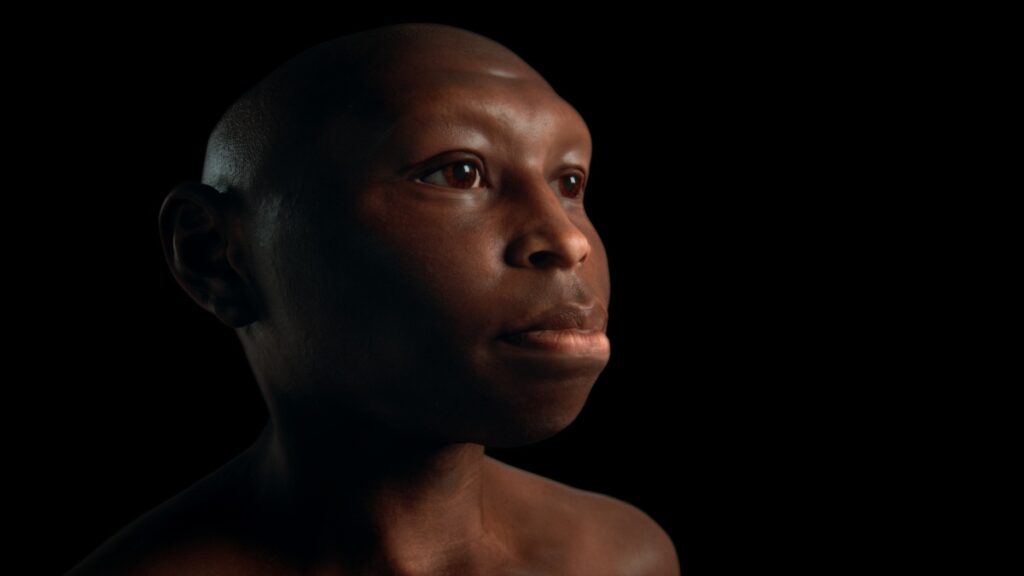
When BBC Studios Science Unit began planning Human, its latest five-part series for BBC2 and PBS Nova, the creative brief posed an age-old problem: how do you show audiences what our earliest ancestors really looked like? The series, fronted by paleoanthropologist Ella Al-Shamahi, set out to explore how Homo sapiens became the sole surviving hominin species. Its narrative spans hundreds of thousands of years – vast stretches of time that left behind no written record and precious little beyond scattered fossils.
For the production team, reconstructing the past convincingly meant striking a careful balance. Too much artistic license could tip the visuals into speculation. Too much restraint might risk losing the cinematic spark required to engage viewers. The solution would have to be scientifically grounded yet creatively compelling, cinematic yet credible.
UK’s VFX studio Lux Aeterna was tasked with solving this challenge. Having previously worked on Secrets of the Neanderthals – a Netflix co-production with the BBC – the studio was familiar with the complexities of dramatic reconstruction. Secrets relied on prosthetics to bring Neanderthals to life, which had proved effective but were logistically difficult for remote shoots and not easily scalable across multiple species and time periods. The production team for Human chose a different approach.
This time, the BBC wanted something more sustainable and flexible. “From the earliest stages, Lux Aeterna was involved in shaping the visual language of the show,” said Lux Aeterna executive producer Emma Kolasinska. “The BBC had been planning this series for over a year before shooting started, which meant we had the opportunity to problem-solve collaboratively rather than retrofit VFX in post.”
That early involvement was crucial. Rather than waiting until the edit to determine what visual effects were needed, Lux Aeterna helped establish the pipeline from the ground up. The studio explored a range of possible solutions – facial tracking, digital make-up, even enhanced prosthetics – but all proved as costly and technically demanding as traditional methods.
As compositing supervisor Tav Flett recalled, “We explored everything from facial tracking to digital makeup. But the technical complexity and cost of those solutions ended up being just as high as prosthetics. That’s when we proposed a photogrammetry-led approach.”
Photogrammetry at the heart of the process
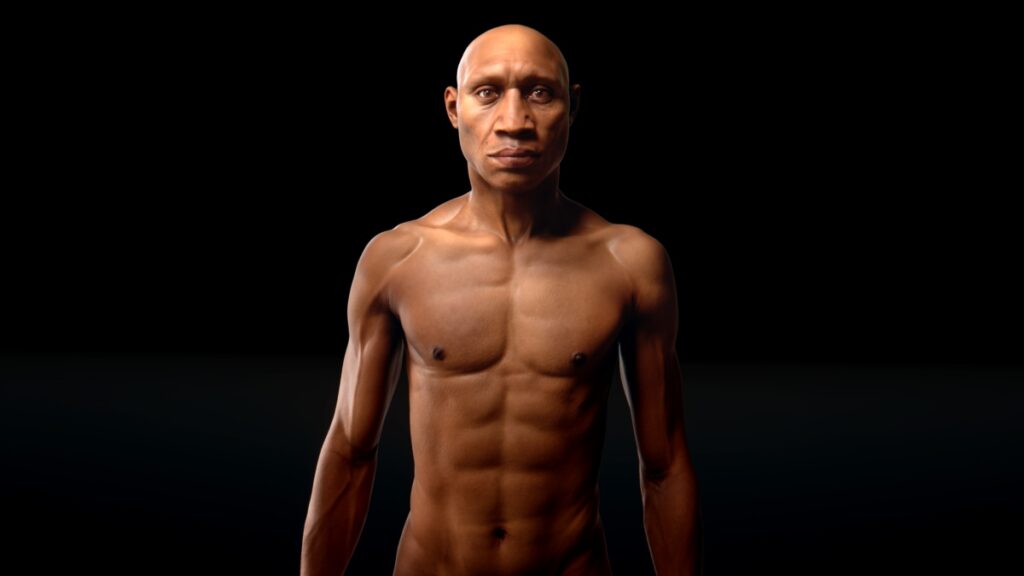
Working with London-based photogrammetry specialists, Sample & Hold, the VFX studio devised a workflow that used ultra-high-resolution body scans as the foundation for reconstruction. The aim was to build four historically accurate avatars, representing the people of Jebel Irhoud in Morocco (some of the oldest known fossils of Homo sapiens), as well as Homo Floresiensis and Homo Erectus.
Casting played an essential role. The production team sought performers whose physiques reflected the proportions of the early human archetypes. These actors were then scanned under carefully controlled conditions in Sample & Hold’s studio to ensure data fidelity and cultural sensitivity.
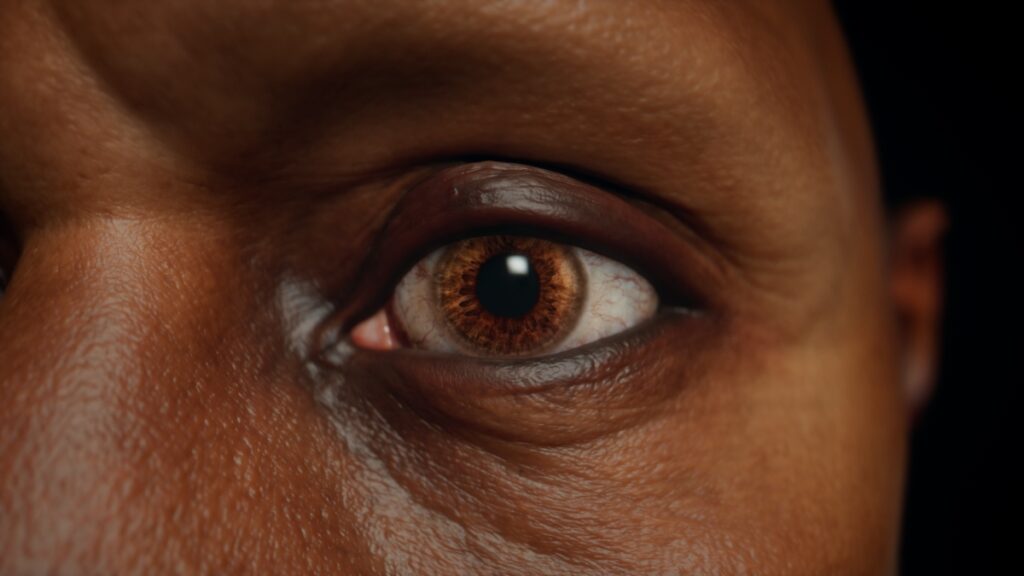
The raw scans provided photorealistic surface detail and geometry – pores, folds of skin, facial contours – but they were only the starting point. Lux Aeterna’s team refined the models further, guided by skeletal data and research provided by BBC scientists. Bone lengths, joint placement, facial proportions, and cranial structures were compared against anthropological records. Every ridge and contour had to withstand close scientific scrutiny.
“This wasn’t about stylised VFX,” Flett stressed. “The models had to be millimetre-accurate. We went back and forth with the BBC’s scientific advisors to make sure every detail aligned with fossil evidence.”
From scans to screen
The photogrammetry-based avatars became central to two of the five episodes. For the first time, audiences could see accurate digital reconstructions of early humans rendered as individuals rather than abstract diagrams or artistic sketches.
Lux Aeterna CG supervisor Timmy Willmott explained, “They served as a visualisation of what these early humans would have looked like as individuals. Developed closely with science professionals to ensure their accuracy, they helped to reveal the similarities and differences to modern humans.”
Once developed, the avatars were used in multiple ways. In some instances, they were composited directly into filmed environments as digi-doubles, enabling the production to populate remote archaeological locations without transporting actors or prosthetic teams. Elsewhere, the reconstructions appeared as standalone visualisations, offering audiences an intimate, face-to-face encounter with our ancestors.
This approach proved far more flexible than prosthetics, enabling the team to extend the series’ reach across time and geography without escalating production costs or compromising authenticity.
Supporting the story with VFX
The VFX studio’s contribution went far beyond the human reconstructions. To enhance the documentary’s sense of place, the team created a variety of additional CG assets. A woolly mammoth makes a striking appearance in one episode. Digital set extensions, 2D clean-up, and additional props helped align filmed locations with their historical counterparts while keeping the aesthetic firmly rooted in documentary realism.
One of the most ambitious tasks was the creation of animated maps and timelines to illustrate the migration, development, and eventual disappearance of ancient human species. Built from datasets provided by BBC researchers and consultants, these graphics allowed the audience to follow movements across continents and understand the interplay between climate, geography, and survival.
“Migration, early farming, the development of writing, and even the disappearance of land bridges – these were key narrative beats,” said compositing director Steve Burrell. “We had to find a way to represent them visually, while remaining sensitive to complex variables like rising sea levels and shifting climates.”
A particular challenge lay in visualising changing coastlines and submerged landmasses. The studio created bespoke transitions and overlays to help viewers track these shifts over millennia, while maintaining a visual style consistent with the series’ grounded, cinematic approach.
Towards a new model for factual filmmaking
In total, the studio delivered 60 VFX shots across five episodes. The work ranged from photorealistic reconstructions to subtle environmental adjustments, but the unifying principle was restraint. The effects never sought to overwhelm or distract, instead serving the story and the science.
With its hybrid use of photogrammetry, scientific consultation, and minimalist compositing, Human offers a model for factually rigorous historical reconstruction on television. It demonstrates that high-end VFX need not be indulgent or cost-prohibitive, but can instead be a precise tool for storytelling in science-based documentaries.
The series premiered at Sheffield DocFest, where audiences had the chance to see not only the finished work but also behind-the-scenes breakdowns shared on BBC Earth. These glimpses underscored the meticulous craft behind each decision and the collaborative spirit that carried the project from concept to broadcast.
For Lux Aeterna, Human reflects an ethos of cross-disciplinary innovation – bringing science and visual effects into alignment. Hifle concluded, “The whole point was to bring our ancestors to life in a way that was visually compelling, but also respectful of the science. We weren’t just creating shots. We were creating understanding.”
