
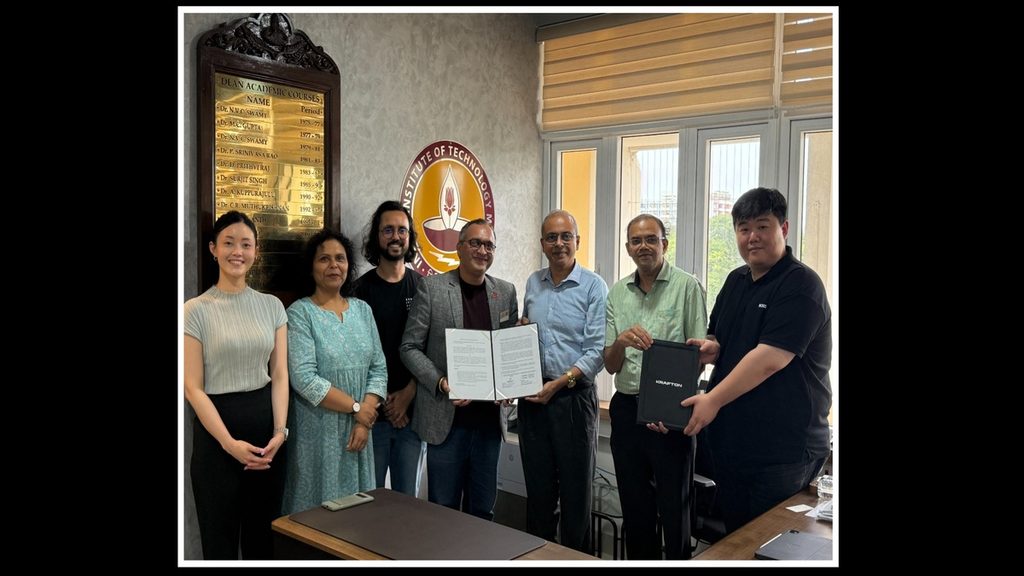
India’s gaming talent pool is getting a new power-up. Krafton India has launched Kigi Academy, an industry-academia initiative aimed at building a stronger pipeline of game developers, designers and creators in the country.
The programme kicks off with a partnership with the Indian Institute of Technology Madras (IIT Madras), giving students hands-on exposure to the nuts and bolts of game development, from coding, game design and UI/UX to art and product development. And this is no classroom-only exercise.
The six-month, fully funded programme combines 16 weeks of on-campus learning at IIT Madras with an eight-week immersive residency at Krafton India’s headquarters in Bengaluru. The inaugural cohort will comprise 30 students, with 10 progressing to the residential phase through an online application, screening and personal interview process.
The programme is open to IIT Madras students in their third and fourth years of bachelors and dual degree programmes, as well as postgraduate and master’s students from any engineering discipline. No prior game development experience is required, a useful feature for students looking to turn a gaming obsession into a career.
The first 16 weeks will focus on core game development skills using the Unity engine, with a particular emphasis on mobile gaming and collaborative weekly builds. Participants will then move into the eight-week residency, getting a taste of real-world production workflows before developing and showcasing a final vertical-slice game.
Industry mentors will guide students through the process while introducing them to Krafton’s global development standards. For the standout performers, there is an extra level to unlock: opportunities to join Krafton India in full-time roles.
Krafton incubator programme head and Krafton India publishing director Anuj Sahni, said the initiative is designed to bridge the gap between academic learning and the realities of game development. “India has no shortage of exceptional engineering and creative talent. What has been missing is a structured pathway that bridges academic learning with the realities of game development.”
Sahni added that Kigi Academy will allow students to understand the complete game-making journey, spanning ideation, design, development, user experience and publishing, under the guidance of industry professionals.
Krafton India people operations head Saurabh Shah said the programme would help identify promising talent early and create clearer pathways from education to gaming careers.
IIT Madras academic courses dean Prof. Prathap Haridoss said the partnership demonstrates how academia and industry can work together on real-world challenges, while giving students practical exposure to game development.
Kigi Academy is not being built from scratch. It borrows from Krafton’s game-development training playbook in Korea, particularly Krafton Jungle, an intensive project-based residency launched in October 2022.
Rather than relying on classroom-style instruction, Jungle puts participants through the full game-development cycle from prototype to public launch while strengthening their technical and collaborative skills. Krafton aims to scale the programme to train 1,000 developers annually in Korea.
The Jungle programme’s operators will also mentor developers selected for the Kigi initiative, bringing that hands-on, learn-by-building philosophy to India. The curriculum, however, is being adapted for the country’s mobile-first and rapidly expanding gaming market.
The choice of IIT Madras as Kigi Academy’s founding academic partner is also rooted in an existing relationship. Krafton India has maintained a multi-year campus association with the institute through Rendezvous, technical festivals and game jams, with previous engagements leading to full-time offers for IIT Madras students.
With Kigi Academy, Krafton is betting that the next generation of Indian game makers need less theory and more time in the engine room. The message is simple: build games, build skills and build careers.
