
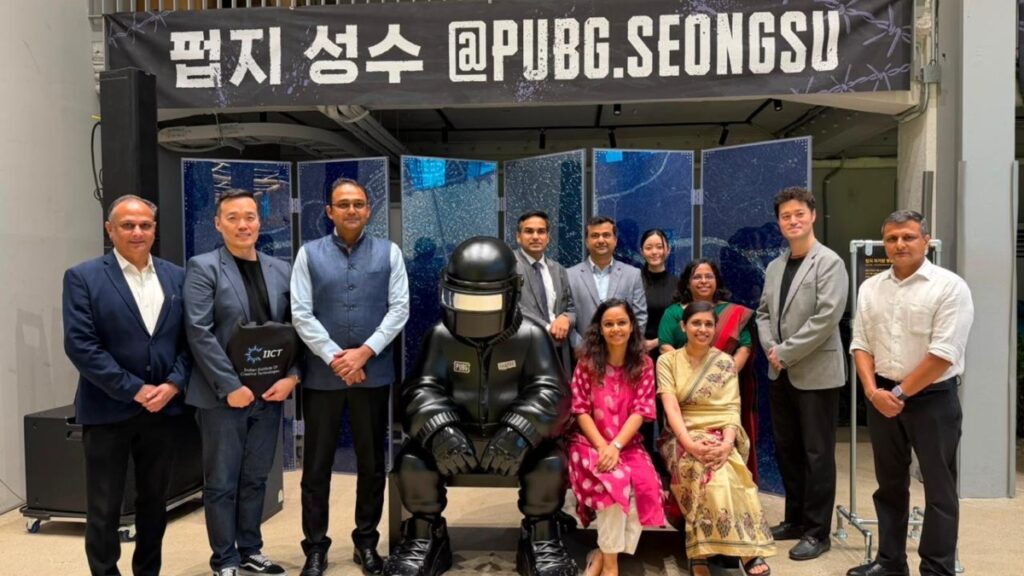
If India is serious about becoming a global creative powerhouse, it is learning from the masters. The Indian Institute of Creative Technologies (IICT) joined the official Ministry of Information & Broadcasting (MIB) delegation to the Republic of Korea and Japan on a knowledge exchange mission focused on AVGC-XR, gaming, animation, manga, creative technologies, content infrastructure, digital media, start-up incubation and global best practices for the proposed Content Creation Labs initiative.
The delegation was led by the ministry of information & broadcasting’s joint secretary Shruti Singh. Other members included press registrar general of India Ashutosh Mohle; indian information service assistant director Bineet Kaur; Indian Institute of Creative Technologies (IICT) chief executive officer Vishwas Deoskar; and IICT chief operating officer Ninad Raikar.
In the Republic of Korea, the delegation met Munhwa Broadcasting Corporation (MBC) to discuss broadcasting innovation, digital transformation, production workflows and global content distribution. At Krafton, discussions centred on gaming, AI-enabled content creation, developer talent pipelines, start-up incubation and interactive entertainment, while Krafton Jungle Lab showcased its residential talent development model in software AI, game development and game technology.
The delegation also visited the Art Convergence Centre at Korea National University of Arts (K-Arts) and met the Ministry of Culture, Sports and Tourism (MCST) and the Korea Creative Content Agency (Kocca) to study Korea’s support ecosystem for animation, gaming, broadcasting, comics, webtoons, music, XR, start-ups, exports and creator development. Visits to Hongneung Talent Campus and the Seoul Film Centre offered insights into talent development, film education, creator support and creative infrastructure relevant to strengthening India’s AVGC-XR ecosystem.
The Japan leg of the tour included meetings with Mainichi Broadcasting System (MBS) on content innovation, digital transformation and audience engagement, as well as the International Professional University of Technology, Osaka, which focuses on industry-oriented education in digital entertainment, information technology and emerging technologies.
In Kyoto, the delegation visited Kyoto Seika University, the Kyoto International Manga Museum and the Ritsumeikan Centre to understand Japan’s approach to manga, animation, creative education, game studies, digital archives, original IP creation and interactive media innovation.
The Tokyo programme featured visits to Digital Hollywood University, where the delegation explored interdisciplinary education across 3DCG, VFX, game programming, film, anime, web, VR, AR, media arts and entrepreneurship. Meetings with the ministry of economy, trade and industry (Meti) highlighted Japan’s strategy of treating content as a key economic and export sector, with globally successful franchises such as Pokémon, Hello Kitty, Mario, Anpanman and Shonen Jump demonstrating the value of long-term IP creation.
The delegation also met the agency for cultural affairs under the ministry of education, culture, sports, science and technology (Mext) to understand creator support, human resource development, production support, overseas dissemination and industry-academia collaboration. The programme concluded with visits to Bandai Namco Pictures, Kodansha, the Tokyo Contents Incubation Centre (TCIC) and Toei Animation to gain further insights into animation production, publishing, incubation and creator-led businesses.
Commenting on the visit, IICT chief executive officer Vishwas Deoskar said: “IICT’s participation in the MIB delegation to the Republic of Korea and Japan provided an opportunity to study some of the world’s most evolved creative technology and content ecosystems. The engagements across broadcasting, gaming, manga, animation, creative education, policy and incubation will contribute significantly to IICT’s efforts to build industry-aligned programmes, support original IP creation and strengthen India’s AVGC-XR ecosystem.”
The learnings from the visit will support IICT’s ongoing work in talent development, research, start-up incubation, policy, original IP creation and the proposed Content Creation Labs initiative, helping adapt global best practices for Indian creators, students, start-ups, institutions and industry partners.
From Seoul’s gaming labs to Tokyo’s animation studios, the tour was more than a study visit; it was a blueprint for building India’s next generation of creators and content businesses.
