

India’s esports revolution isn’t coming; it’s already loading.
As India’s orange economy continues to surge, the 2026–27 union budget sent a strong signal: gaming and esports are no longer just entertainment; they’re viable, scalable career paths. The move has been widely welcomed across the industry, with stakeholders now pushing for esports policies that match the structure and recognition of traditional sports.
Yet, the journey isn’t without its challenges, as highlighted in the latest 2026 EY report by the Federation of Indian Chambers of Commerce & Industry (FICCI).
A year of reset, not retreat
According to the Ficci EY 2026 report, esports in India experienced a 7.5 per cent decline in 2025, primarily due to:
- A global slowdown that reduced ad spends by international sponsors
- A sharp drop in funding from Indian money gaming brands following regulatory restrictions
Despite this dip, the broader narrative remains optimistic. The industry is not shrinking, it’s recalibrating.
The numbers tell the story
- Industry growth: Video games and esports grew nine per cent in 2025
- Market projection: Expected to grow from Rs 63 billion (2025) to Rs 92 billion by 2028 at a 13 per cent CAGR (Compound Annual Growth Rate)
- Tournament participation: Crossed 2.8 million players in 2025
- Esports titles: Increased to 20 prominent titles
- Professional teams: Reached 40 teams
- Broadcast scale: 9,500 hours of live and recorded content across 18 platforms
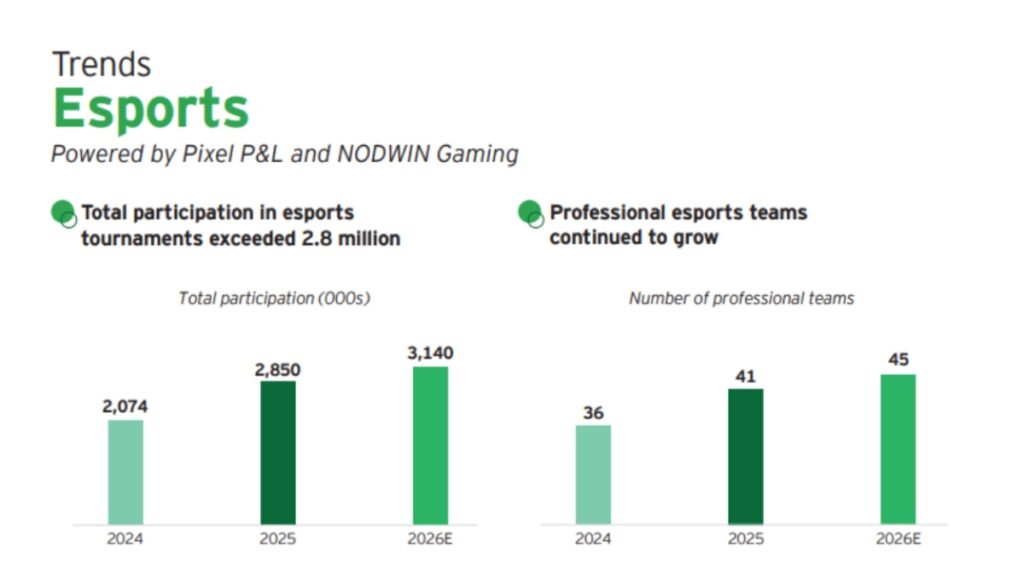
Mobile devices remain the backbone of participation, while PC and console ecosystems continue to shape aspiration and quality benchmarks as the report suggests.
In 2025, India’s gamer base grew steadily, the reason being esports-driven discovery through streaming platforms, short-session gaming formats, and creator-led communities.
India is no longer just playing global games; it’s building them!
Homegrown titles are beginning to carve a space in competitive gaming. For example, Indus Battle Royale, developed by Pune-based SuperGaming, hosted a nationwide esports tournament with a significant prize pool. Indian titles like Fau-G are also entering the competitive ecosystem.
This marks a shift from consumption to creation.
Policy push changes the game
The government’s intervention has been a turning point in expanding the growth of the AVGC sector. The key developments included in the report are:
- The Promotion and Regulation of Online Gaming Act, 2025 (PROGA) formally distinguishes esports from money gaming
- Esports is now officially recognised as a competitive sport under national policy frameworks
- Participation fees and prize pools are permitted (excluding betting/wagering)
Apart from that, several states are actively building esports ecosystems, including Karnataka, Tamil Nadu, Rajasthan, Bihar, Nagaland, Telangana, and Kerala. Bihar has integrated esports into school and college curricula. Tamil Nadu hosted the Chennai Esports Global Championship (2025).
Additionally, esports has been featured at Khelo India events, signalling early integration into India’s sporting fabric.
India on the global map
Indian esports is gaining international credibility, as the report specifies:
- Ved Bamb became India’s first esports world champion at the Pokémon Go World Championship
- Events like the Esports Nations Cup 2026 are expected to elevate India’s global presence
At the corporate level, Indian companies are also expanding globally. Nodwin gaming has acquired global tournament organiser StarLadder, along with multiple IPs such as AFK Gaming, Trinity Gaming, and Comic Con India, signalling India’s ambition to lead the global esports ecosystem.
What’s next for the industry?
As per the report, industry leaders believe the next phase will be defined by consolidation, not chaos.
Nodwin Gaming co- founder and managing director Akshat Rathee highlighted, “Indian esports is entering a consolidation phase where stable, title-specific ecosystems will matter more than rapid expansion. The growing prominence of Moba Legends: 5v5! and Honour of Kings will diversify participation, while events like the Esports Nations Cup 2026 will strengthen India’s global competitive presence.”
JetSynthesys founder and CEO Rajan Navani emphasised, “Video gaming and esports are no longer subcultures; they are mainstream community ecosystems.”
India’s esports ecosystem is evolving from a fragmented space into a structured, high-growth industry. With regulatory clarity, rising participation, and stronger institutional support, the foundation for long-term sustainability is firmly in place.
